Trenton Doyle Hancock Taps Heroism and Anti-Heroism at SCAD MOA’s ‘In Character’
The exhibition is on view at SCAD MOA until June 8.
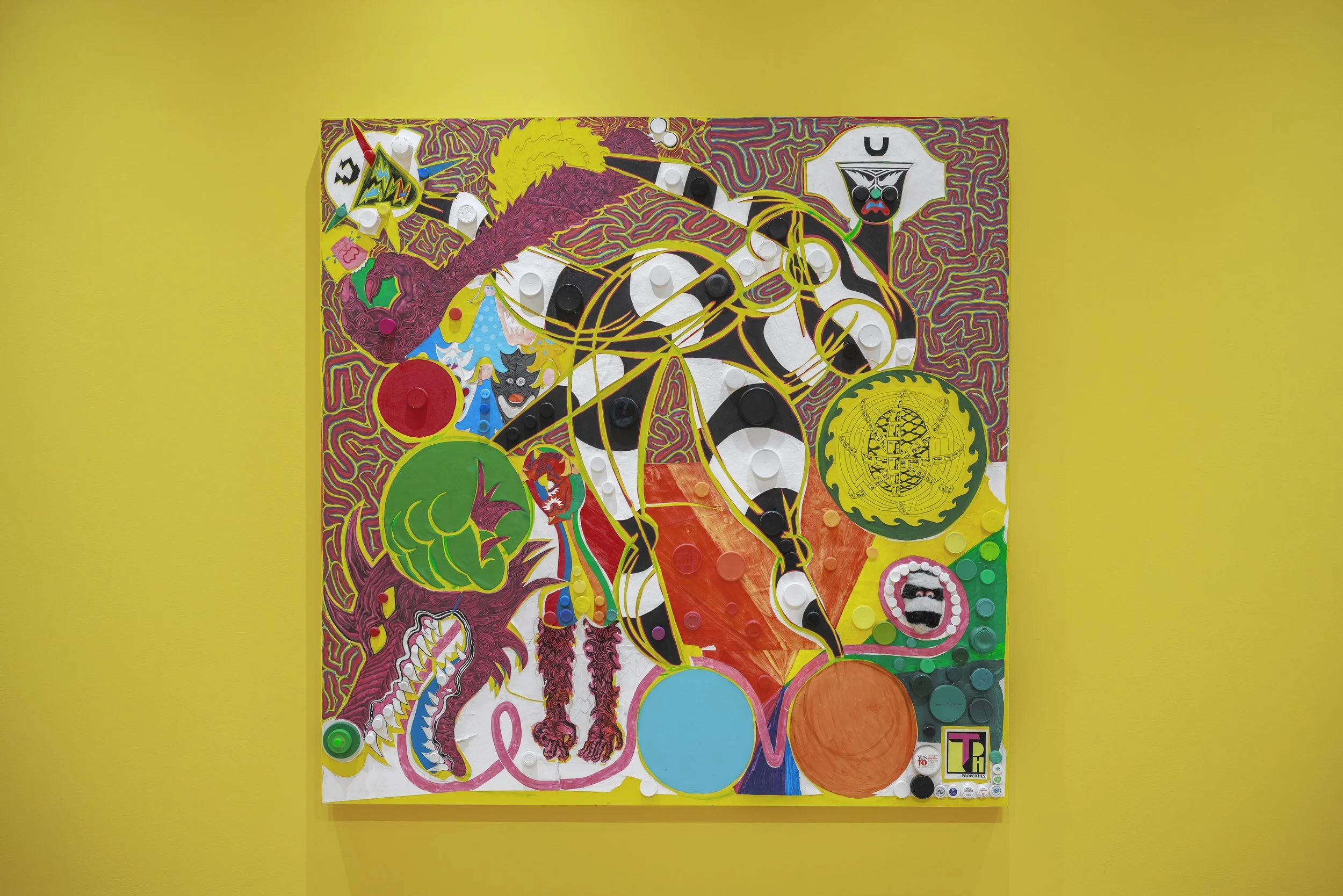
Image Courtesy of SCAD MOA
When you’re raised in a rural, Christian, conservative environment like Trenton Doyle Hancock’s upbringing in Texas, representation and your overall outlook on life can significantly impact how you navigate im society. As people around him continuously tried to dictate his future based on stereotypes, Hancock knew he was destined to become the complete opposite of what everyone told him.
As part of the group exhibition, In Character, Hancock expands on his mythological world, the Moundverse. On view until June 8 at the Savannah College of Art and Design Museum of Art’s deFINE ART exhibition, Hancock delves into his realm of grandiose self-characterization, power, experiences, and reclamation. In Character uses animation to confront the erasure of Black representation in multimedia arts, while also emphasizing the importance of Black culture and experiences within that world.
During Hancock’s childhood and beyond, superheroes looked nothing like him. Clark Kent, Batman, and other characters were almost always white men until recently, when characters like Spider-Man became more diverse. Because of this, Hancock thought about what a hero is to him, and his capability to see himself as his own hero.
Hancock spoke with 1202 MAGAZINE about the birth of the Moundverse, how he pieces collages into scaled pieces, and how his artwork became the antithesis of everything he was told to be, while he knew who he really was meant to be.
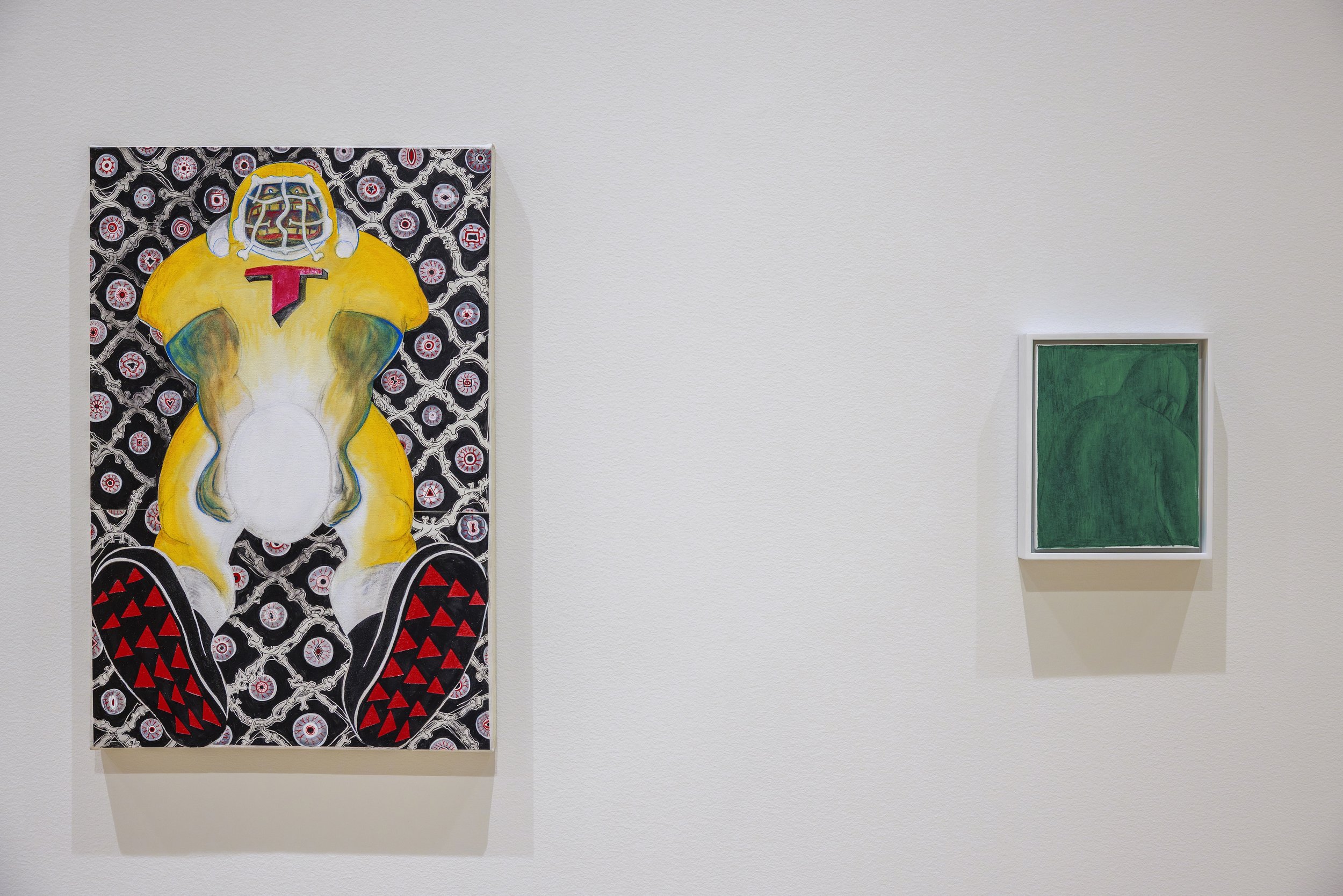
Image Courtesy of SCAD MOA
Why do you think the curators chose these particular artworks of yours to be featured in In Character?
There’s diversity in my practice and in these works—various scales, and dividing the narrative across works and mediums. SCAD did a great job of showing the breadth of my graphic practice.
When did the Moundverse come into your artistry?
I would argue that it came to be as soon as I started drawing. It retroactively absorbs all of my childhood work as well, but when I knew this was what I wanted to do with my adult conscious mind, it was around 1999. I found a format that I could plug all of these things into, and that became the first stages of developing the Moundverse, which was towards the end of graduate school.
Did any one moment or experience kickstart the universe, or was it a plethora of thoughts, memories, and experiences?
After graduate school, I moved back to Texas from Philadelphia. Someone asked me a question, and I was ready to unpack so much stuff that I had just discovered in graduate school, but I didn’t know exactly how I was going to do it. They asked me, ‘What do mounds eat?’ I said, ‘I’ve never thought of that.’ So, I created this character but hadn’t thought about it deeply. That one question sparked so many more questions, but I knew it could have a history and inner workings. One thing led to another, and the world-building started to take hold of this idea.
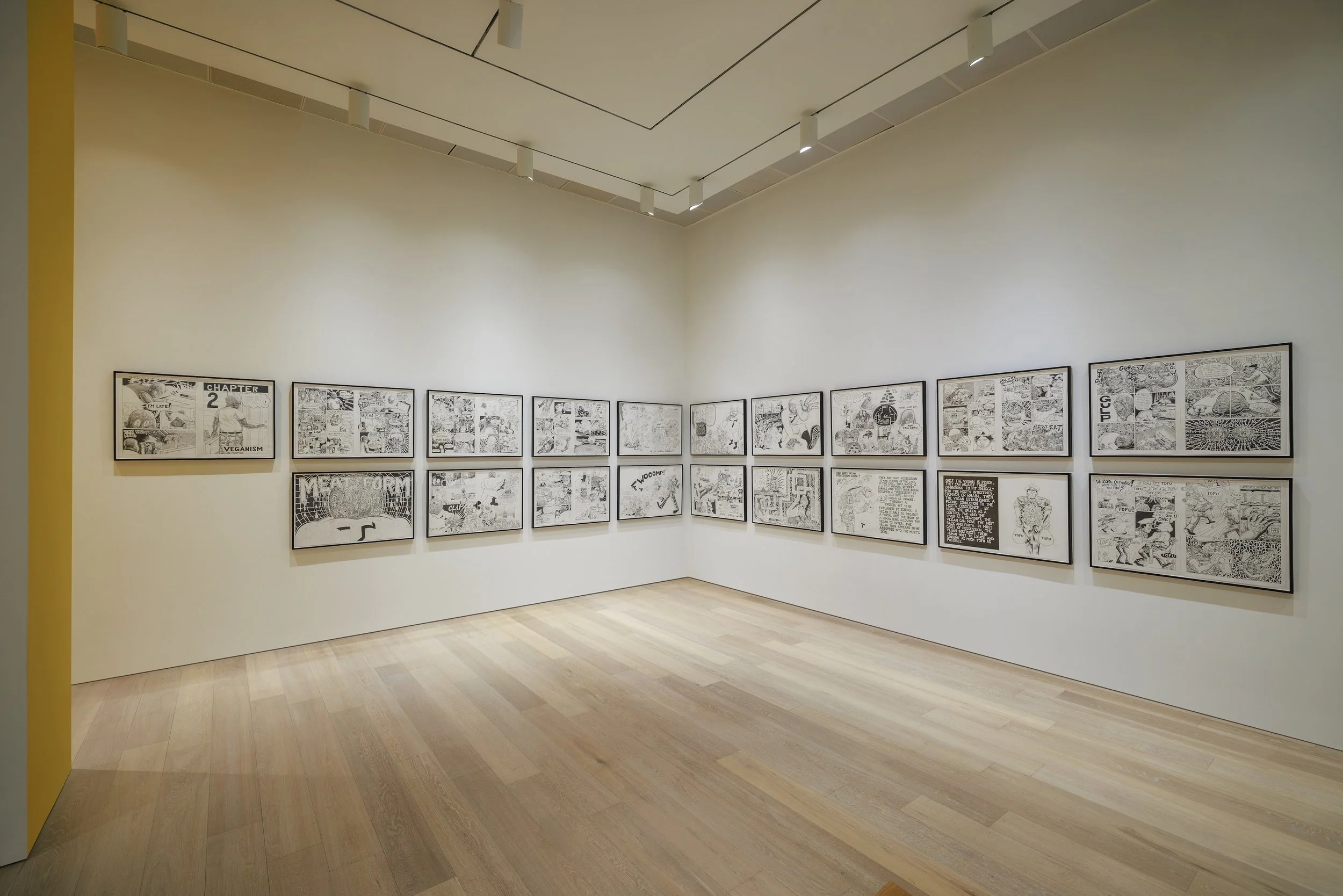
Image Courtesy of SCAD MOA
As I looked at many of your pieces, I assumed you created them all on one canvas, but the more I looked, the more I realized they were more like collages. How did you incorporate all of the collages to create one cohesive piece?
Oftentimes, I’ll start each collage piece on its own, autonomous from the other ones, not looking at them. But at some point, I want to put them side by side. I start to work through the connections between the two. If you look closely, you can see the dividing point of where the paper begins and ends. The thing that connects them first and foremost is this lattice work. Some people call it a chain-link fence, but this is a pattern you see woven through the work. That ties the bounds of all of the disparate materials together and keeps me conscious of where that pattern laces through.
You have other materials in your works, such as plastic bottle caps. How did these help complete the pieces?
Plastic bottle caps are generally the last elements to go into a painting. They act as another way to bind the two sides of the work together and create these plot points. They remind me of globs of paint because I use acrylic paint, which is also plastic. It’s an extension of the material I was already using.
How do you decide whether to create a black-and-white or a colorful piece?
Ultimately, it comes down to the characters and if the narrative calls for color. If it doesn’t, I don’t use color. Color has to be quite intentional, and I would argue that black and white are their own kinds of color and have their own impact. I find the color as I’m going through the work. It’s a moving target that always changes.
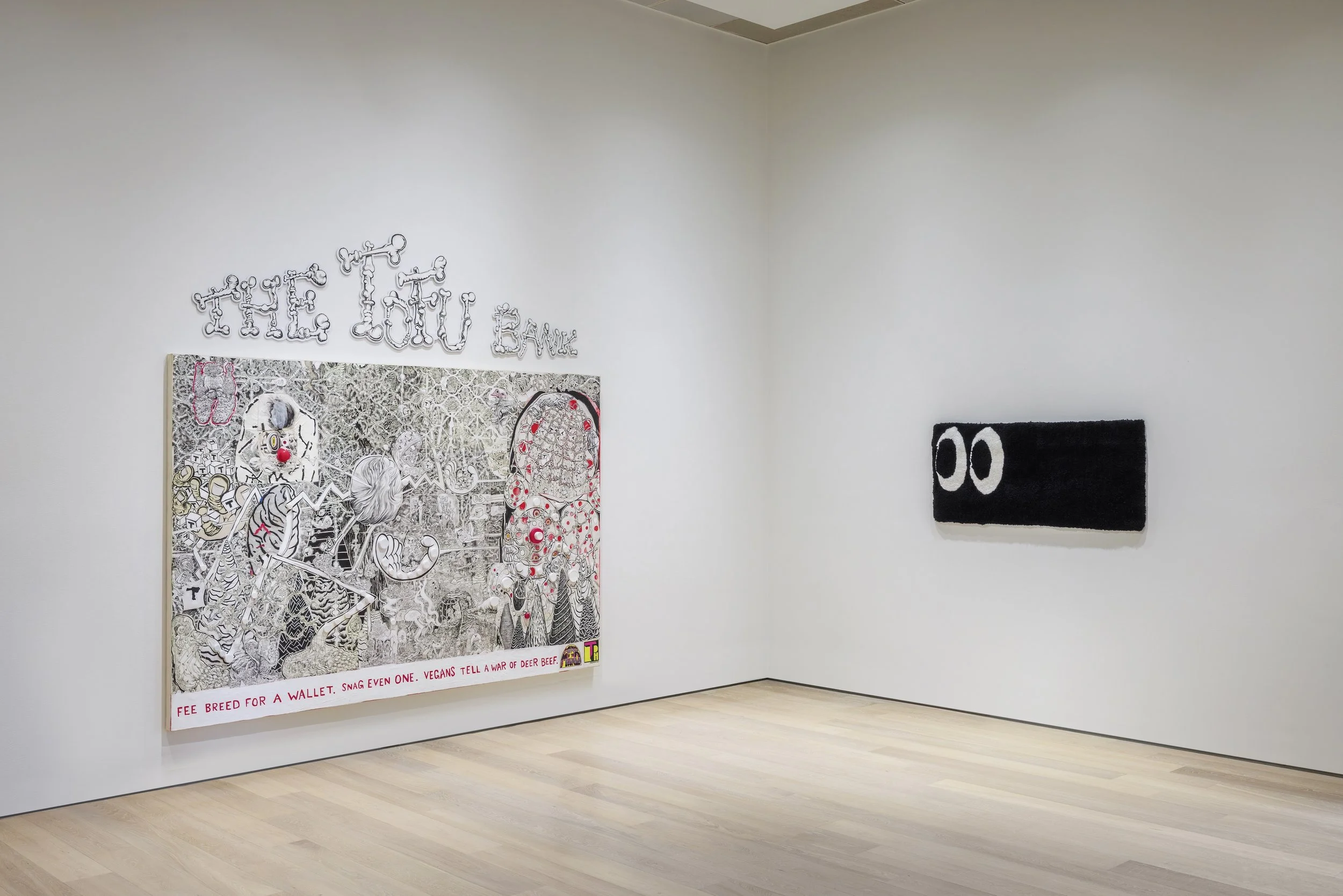
Image Courtesy of SCAD MOA
Growing up in Texas, what does representation, or the lack thereof, mean to you when you’re creating these characters in the Moundverse?
Growing up, I didn’t even know what Africa was. There was a back-to-Africa movement, and I wondered how I could return to a place I had never lived in. It was always a skeptical language. People would tell me I’m a jock because of my build. Others told me I needed to be a narrator, speaker, or minister because of the way I carried myself, which I didn’t want to do either. The conscious thing I knew I had to do was leave home at a certain point to be around people who might understand me better than my folks at home. That was my hero’s journey.
Would you say your upbringing was the antithesis of the kind of work you make now?
I think there’s a great full circle in my work since I left home. Everything I did was the opposite of what my home life was. The more work I do and the more self-discovery I have, the more I realize I am still of that material. I’m now creating my own religion after being bound by religion as a kid. There are grand aspirations to escape yourself and find a new self. There’s an irony that you oftentimes double-back and settle into the most perfect version of that younger self. You transform a space and make it what you need because there’s a sense of comfort there. Even the traumatic aspects have protection. I needed armament as a cautionary tale.
Throughout the years, do you think you’ve achieved self-discovery through your work, or are you still evolving in your artistry?
I’m finding new parts of myself and potentiality all the time. Once that stops, you’re dead. I really value being upended, and the beauty of not knowing is not something I always look forward to.